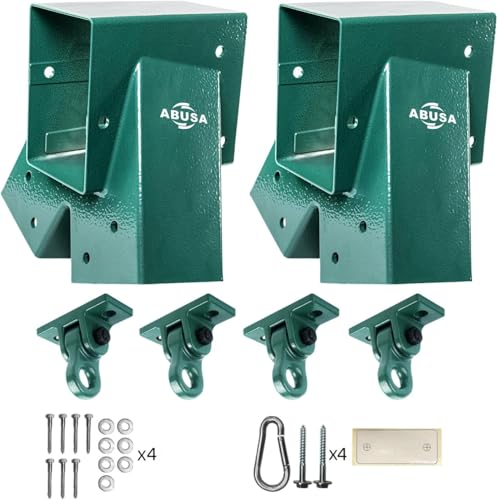
Green A frame brackets with four hangers
$69.98
Rated 4.1 of 5585 ratings on the listing

A frame arrives with a designed capacity. A tree gives you indirect signs and asks you to judge.
A frame is a manufactured thing with a stated design load and known joints. A tree is a living structure whose condition you infer from the outside. That is the whole difference, and it is why the guidance for trees is a list of signs rather than a number.
The commonly published minimum is eight inches in diameter, and the more cautious sources say ten. The branch should also not be more than about half the thickness of the trunk it grows from, because past that the joint at the trunk is carrying more than the trunk wants to give.
It has to be horizontal. A sloped branch turns a swing into a pendulum that drifts sideways on every pass, and the rider corrects for it without noticing until they are somewhere unexpected. Height matters too: published guidance keeps the mount below roughly fifteen to twenty feet, partly for the chain length and partly because a longer chain means a wider arc and a much bigger area to keep clear.
Mature hardwood is what the guidance asks for, with oak, maple and sycamore named most often. Willow, birch and ash come up as the ones to avoid, and conifers generally, because the wood is softer or the branch structure is wrong or both.
Position on the branch is three to six feet out from the trunk. Closer than that and the branch is too stiff to be reading, further and the leverage on the trunk joint grows fast.
Get a rope over the branch and pull down on it hard with your own weight, several times, and watch the branch rather than the rope. Deadwood tends to announce itself under a real load. It is not a proof, it is a filter, and it catches the branch that would have failed on the first afternoon.
Look for cracks where the branch meets the trunk, for fungus at the joint, for bark that comes away, and for a branch that has already dropped a smaller limb.
The one point every source agrees on: use a strap, not rope or chain wrapped round the branch. Rope and chain cut into bark and girdle the branch over a season, and a girdled branch dies at the far end. Hanging kits with straps run under twenty five dollars, which is a small number next to the tree.
If you are working with rope elsewhere in the setup, published figures put a working load near two hundred pounds and a breaking strength near two thousand. Those two numbers are ten times apart for a reason, and the small one is the one to plan with.
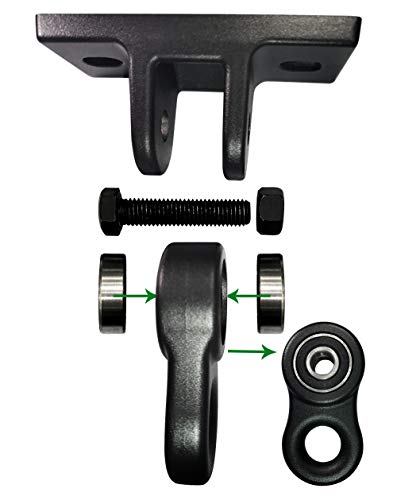
Our hangers are made to bolt through timber, which is a beam or a frame rather than a living branch. On a tree the strap goes over the branch and the hardware lives below it. Read the two as separate jobs.
Rated 4.1 of 5585 ratings on the listing
Rated 4.7 of 57,298 ratings on the listing