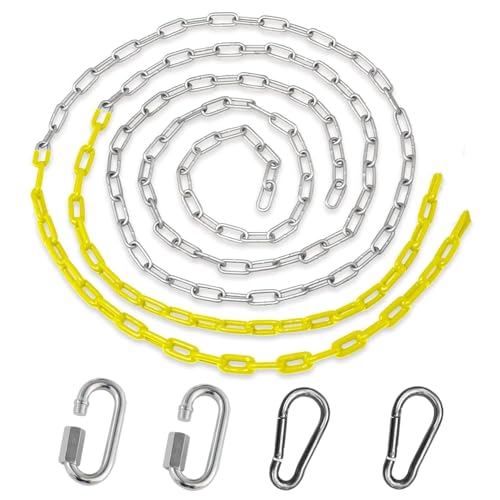
66 inch swing chains with quick connect hooks
$24.99
Rated 4.9 of 537 ratings on the listing

The smallest published number in the whole subject, and the reason it exists.
A gap in an S hook must be no wider than four hundredths of an inch. That is both loops, and the second one is the loop people forget. It is the tightest tolerance published anywhere in playground guidance and it has nothing to do with strength.
The reason is clothing. A drawstring, a hood cord, a jacket toggle. A gap you can barely see is a gap that will take a cord and not give it back, and a child at the top of an arc cannot reach the thing that has caught them.
Four hundredths is thinner than a credit card. If you can see daylight through the hook at arm length, it is open, and eyeballing it from the ground has never once been good enough.
An S hook out of the bin is open by definition. It becomes acceptable only once it has been closed down onto whatever it is holding, and closed to that tolerance rather than to the point where it stops rattling. Most people close them by eye and most people leave a visible gap.
Closing one properly wants pliers and a little patience, and it is worth knowing that a hook closed and reopened a few times has been worked at the bend. Steel does not enjoy that. If a seat has come on and off across three seasons, the hooks are the cheap part of the assembly and there is no argument for keeping the old ones.
A threaded quick link has a sleeve that screws over the opening. Screwed down, there is no gap at all, and you can check it with a fingernail rather than a feeler gauge. Every published comparison in this niche treats the quick link as the correct replacement for an S hook, and that is the honest position.
Screw it fully closed. A quick link left half turned is an open hook with extra steps.
Our chains come with quick connect hooks at both ends, in two shapes, so one end meets a hanger and the other meets a seat without a wrench. Convenient, and worth saying out loud: a connector that opens without a tool also closes without a tool, so check both ends at the start of the season and after anyone has taken the seat down.
The middle of the chain wears a sleeve over the stretch that hands and legs touch, which is there for pinching rather than for strength.
Links wear from the inside where they rub each other, so a chain that looks fine from a distance can be thin at the contact points. Look for links that have gone oval, for a twist that will not hang out, and for rust sitting in the joints where water collects. Rope frays instead, and frayed rope is easier to spot and easier to ignore.
Rated 4.9 of 537 ratings on the listing
Rated 4.7 of 57,298 ratings on the listing