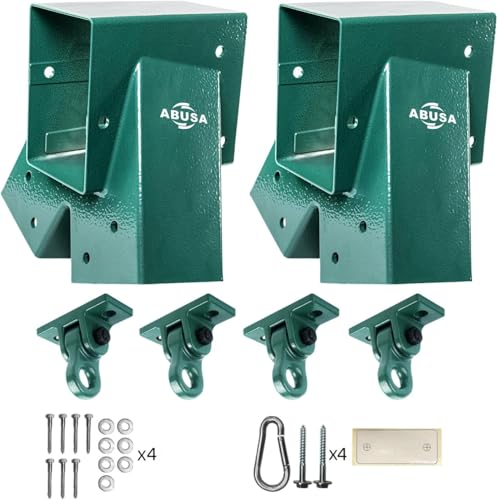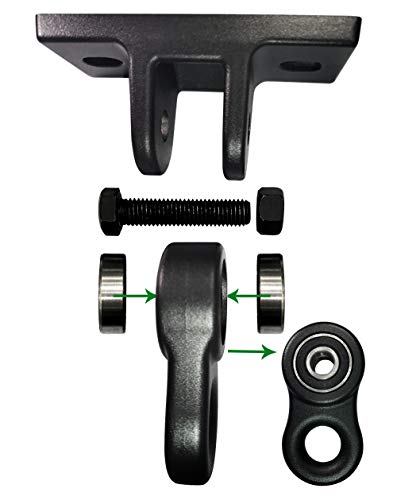
Black swing hangers
from $18.97
Rated 4.7 of 57,298 ratings on the listing

The one decision that gets made wrong most often, and the published numbers that settle it.
A lag screw cuts its own thread into the wood and stops there. A through bolt goes all the way out the far side of the beam and takes a washer and a nut on the back. One relies on the grip of the fibers around a thread. The other clamps the whole beam between two pieces of steel and does not care what the fibers do.
Both are ordinary hardware and both are used on real swing sets. What separates them is not quality, it is how deep your beam is and how much you want the connection to argue with you in year five.
A lag is the normal answer for a solid wooden beam that you own, that is dry, and that is thick enough to swallow most of the screw. The rule builders publish is penetration of at least three quarters of the beam thickness. Engineer Fix states it plainly and adds a margin of at least two to one over the heaviest load you expect, on the grounds that a swing produces a moving load rather than a resting one. A child sitting still and a child at the top of the arc are two different numbers.
Drill a pilot hole. Grimmett uses three sixteenths of an inch under a lag. Eastern Jungle Gym publishes a quarter inch pilot with a five sixteenths working hole. Skipping the pilot in dry hardwood is how you split a beam that was otherwise fine.
Go through the beam when it is thin, when it is a joist you did not choose, when the swing is for adults, or when anything is going to rotate. Clearance holes in the published plans run seven sixteenths of an inch, and commercial hangers that take a carriage bolt want half an inch straight through.
Carriage bolts should be three eighths of an inch at the smallest and the domed head gets countersunk into the wood so nothing stands proud where a hand goes.
Every published instruction says the same thing and it is worth repeating because it is the step people skip: put a washer on before you tighten. Then a lock nut or a lock washer, so the back and forth of a swing does not slowly walk the thread out.
On acceptance, commercial fitters look for no more than two turns of thread standing past the nut. More than that and the bolt is longer than the joint needs.
This one runs against instinct. Tighten to snug, not to the limit of your arm. An overtightened fastener crushes the wood fibers under the washer, and crushed fibers do not spring back. The joint that felt tightest on the day of the build is often the one that has gone slack by the following spring.
Each of our hangers ships with its own lag screw, an oval hook, a washer and a paper drilling template you stick on the beam so the two holes land where you meant them to. That covers the lag route. If your beam calls for a through bolt, that hardware is a trip to the hardware store, and the spec table on every hanger page lists what is in the box and what is not.
Rated 4.7 of 57,298 ratings on the listing
Rated 4.1 of 5585 ratings on the listing