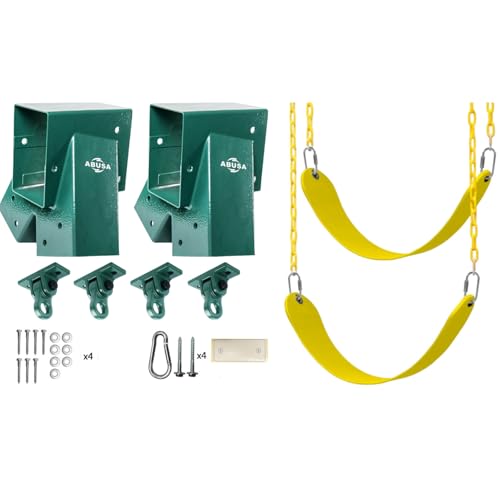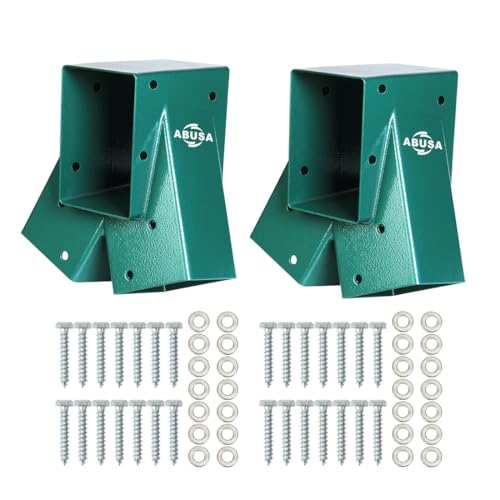
Green A frame brackets, pair
$56.69
Rated 4.1 of 5585 ratings on the listing

A frame rarely breaks. It walks, it rocks, and on one side it lifts. That is an anchoring problem, not a strength problem.
The failure people picture is a beam snapping. The failure that happens is the whole frame rising on one side at the top of the arc and coming back down a few inches from where it started. Do that a few hundred times and the legs have travelled, the geometry is off, and every joint has been worked loose by a load it was never meant to see.
So the question at the bottom of the legs is not how strong the timber is. It is how much the frame is allowed to move.
The cheapest answer is a stake through the foot of each leg, and on ordinary soil it is enough for a small frame with a light seat. The published caution is that stakes lose grip in soft ground, and soft ground includes any ground that has been wet for a week. If you can push a stake in by hand, it will come out by hand.
Stakes also want checking after the first month and after every long freeze. Ground moves; the frame does not.
The step up is a screw in auger anchor, published figures around twelve to eighteen inches long, driven at roughly forty five degrees away from the frame so the pull is along the anchor rather than across it. They hold in soil that will not hold a straight stake, and unlike concrete they come back out when you want the frame somewhere else.
This is the setting most home frames end up in, and it is the one worth trying before anything permanent.
Published guidance sends you to concrete footings, in the region of twelve to eighteen inches deep, in two situations: a slope, and a large or heavily used frame. A metal frame belongs in that conversation earlier than a wooden one, because it is lighter for its size and tips more readily.
Concrete is a decision you make once. Getting a set footing out is a day with a breaker bar and a wheelbarrow, so it is worth being sure the frame is where you want it before the mix goes in. Set the hardware in the wet concrete rather than drilling into it later.
Put a paver or a solid block under each foot, whatever the anchor is. Timber sitting on soil wicks water up the end grain, and the end grain is exactly where the bolts are. A frame that is anchored beautifully and rotting at the ankles is a frame with a short life.
And keep the anchoring in mind when you read a capacity figure. A number on a bracket describes a piece of steel. It says nothing at all about whether the ground under your legs will hold.
Rated 4.1 of 5585 ratings on the listing
Rated 4.1 of 5585 ratings on the listing